Chapter 5. Spin-down Power and the Magnetic Dipole Model
Connect period and period derivative to rotational energy loss, magnetic field strength, braking index, and characteristic age in the classic pulsar parameter framework.
If the previous chapter explains how timing parameters are measured, this chapter asks what those parameters mean. It is the source of many of the quick-reference quantities that appear in pulsar work, including magnetic field, characteristic age, and spin-down power.
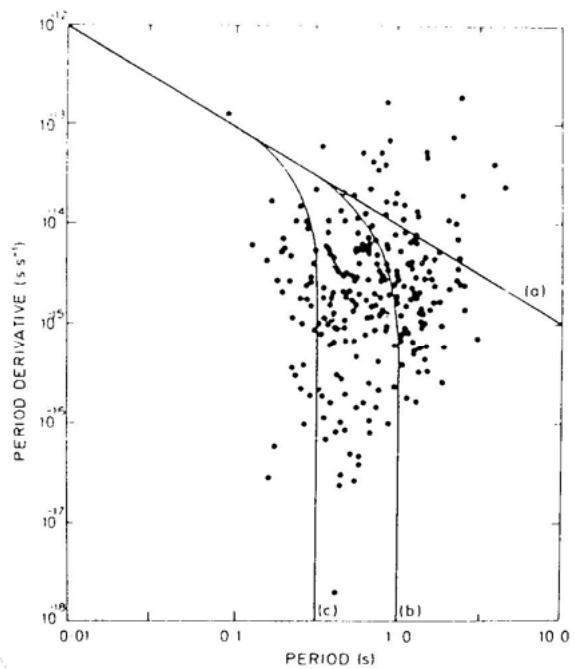
The - diagram is one of the most common diagnostic plots in pulsar research. The fact that different source populations occupy different regions is really a comparison of spin rate against the rate of spin-down.
Why rotational energy is the default power reservoir
The book starts from a simple premise: most pulsars are neither powered by ongoing nuclear burning nor by strong accretion. If they radiate steadily, the source of that energy must come from a reservoir they already possess. The most natural candidate is rotational energy:
If the observed period steadily increases, then the angular velocity is decreasing and rotational energy is being lost. That leads to the classic spin-down power expression:
The power of this formula is that it turns the purely observed quantities and into a directly comparable physical luminosity scale.
Why the magnetic dipole model became the first compact explanation
If a pulsar is approximated as a rotating magnetic dipole, electromagnetic radiation carries away angular momentum and the star gradually spins down. The model is not guaranteed to be complete, but it is powerful because it is:
- structurally simple
- consistent with the observed sign of the slowdown
- able to turn and into an estimate of the surface magnetic field
That is why many parameters listed in pulsar catalogues, such as field strength, characteristic age, and energy-loss rate, are defined inside this framework.
In the most commonly used approximation, the surface dipole field is written as:
Why characteristic age is useful but not sacred
The book gives characteristic age an important role, and that is reasonable because it offers a fast estimate of the evolutionary stage of a source. But it also warns against treating it as an exact true age:
- the initial period may not have been much smaller than the current one
- the braking mechanism may not always be pure magnetic-dipole radiation
- the magnetic field itself may evolve
So characteristic age behaves more like a parameterised clock. It is good for population comparisons, but it should not replace historical or kinematic ages blindly.
Why this chapter is the key to reading the P-Pdot diagram
Many modern pulsar plots place normal pulsars, millisecond pulsars, magnetar candidates, and other classes on the same diagram. This chapter gives you the language needed to read those maps:
- shorter period means faster rotation
- larger means stronger slowdown
- together they set the field strength, characteristic age, and energy budget
Continue with:
Chapter 4. Timing Properties of Pulsar Pulses
Use period, period derivative, binaries, timing noise, and glitches to see why measuring pulse arrival times opens up an entire physical parameter set.
Chapter 6. Radiation Properties of Pulsars
Move from single pulses and subpulses to mean profiles, polarization, and multiwavelength pulse shapes to understand what a pulsar actually looks like in observations.