Chapter 8. The Polar-cap Geometry Model
Use open field lines, emission cones, and position-angle swings to translate mean pulse profiles into magnetic geometry.
This is the chapter that most strongly turns visible shapes into geometry. It asks why, even though we cannot directly resolve the neutron-star surface, we can still infer the geometry of the emission region from pulse profiles and polarization curves.
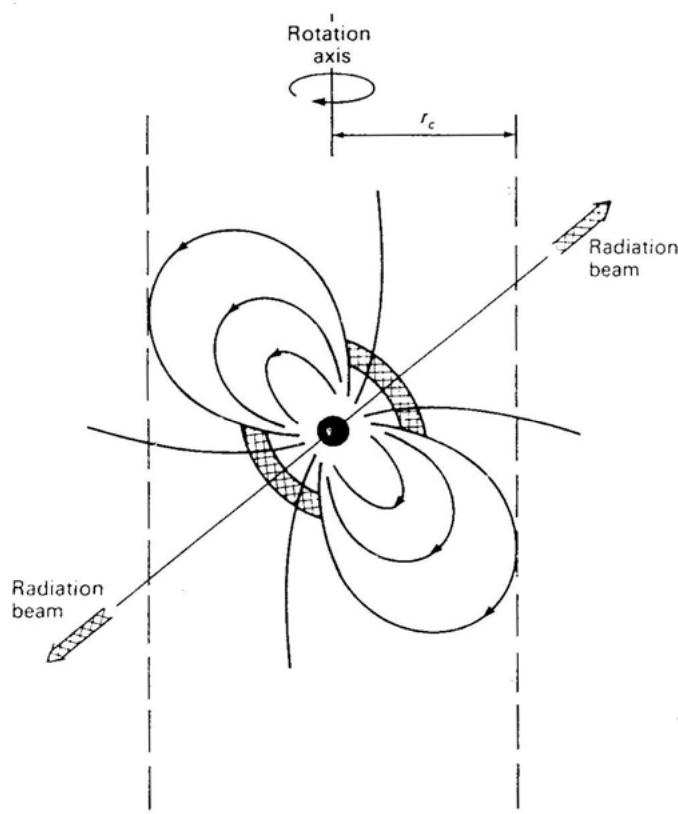
The figure shows the core image behind the polar-cap model: closed field lines trap particles in the inner region, while the open field lines that extend toward the light cylinder provide channels through which particles escape and radiate.
Why the polar cap became the natural candidate
Starting from mean pulse widths, long-term profile stability, and strong linear polarization, the book argues that the emission probably does not arise from chaotic local magnetic structures. A large-scale dipolar field is a better guide. That makes the surface footprint of the open field-line region near the magnetic pole, the polar cap, the most natural radiation window.
The model has two main advantages:
- the geometry is clear
- it connects directly to profile width, magnetic inclination, and how the line of sight cuts across the beam
Why the emission cone is a geometric consequence
Once the field is treated as approximately dipolar, outward emission along open field lines naturally forms a conal beam. Pulse width is then no longer just an empirical number. It becomes a function of beam opening angle, magnetic inclination, and impact parameter.
One of the chapter's important moves is to connect the number of observed peaks to the way the line of sight cuts through the emission cone. Double peaks, broad peaks, narrow peaks, and position-angle swings can all be described within the same spherical-geometry picture.
Why the position-angle swing is such a strong test
The polar-cap model does not only explain total-intensity profiles. It also predicts how the polarization position angle should vary with pulse phase. If a clean polarization curve is available, it can be used to infer:
- the inclination between the magnetic axis and the rotation axis
- the minimum angle between the line of sight and the magnetic axis
- the approximate opening angle of the emission cone
That is why polarization keeps returning throughout the book. Without it, the polar-cap picture is closer to a morphological analogy. With it, the model becomes a geometric framework that can actually be fitted and tested.
Why this helps when reading profiles
If you see any of the following in a profile:
- a double-peaked structure
- peak separation that changes with observing frequency
- a rapid position-angle swing near the main pulse
then you are already looking at the kinds of observables the polar-cap model is meant to explain. For PSRUI users, the main value of the chapter is that it translates visible profile shapes into likely geometric cuts through the beam.
Continue with:
Chapter 7. Radiation Mechanisms of Pulsars
Follow the chain from the magnetosphere and charge separation to particle acceleration, curvature radiation, and inverse Compton scattering to understand the engine behind the mean pulse.
Chapter 9. Millisecond Pulsars and Binary Systems
Understand why millisecond pulsars are treated as recycled objects and how binary evolution rewrites the history of spin and magnetic field.