Chapter 3. Formation of Neutron Stars
Follow stellar evolution, white-dwarf limits, and gravitational collapse to see why neutron stars exist as solar-mass objects on city scales.
The first two chapters establish the observational consensus that pulsars are neutron stars. This chapter moves to a deeper question: why neutron stars exist at all, and why they can exist at such extreme density and such a small scale.
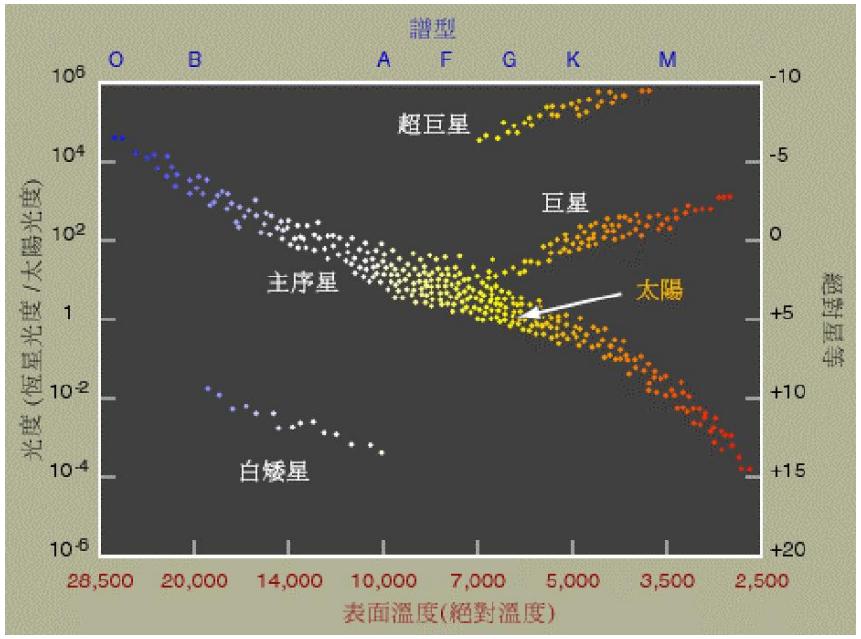
The figure shows the familiar distribution of stars on the H-R diagram. For this chapter, the key point is not merely to recognise the diagram, but to notice that neutron stars are not ordinary members of the main-sequence family. They are compact remnants left behind after stellar death.
From main-sequence stars to compact remnants
The book first lays down the broad picture of stellar evolution: throughout a star's life, inward gravity is balanced against outward pressure. During nuclear burning, thermal pressure offsets gravity. Once the usable fuel is exhausted, that balance breaks and the core begins collapsing toward higher density.
The decisive question is not whether collapse happens, but where collapse stops. The book summarises the outcomes in three broad classes:
- at lower mass, collapse stops at the white-dwarf stage
- at higher mass, it continues to the neutron-star stage
- at still higher mass, even neutron degeneracy pressure is insufficient and the result becomes a black hole
Why white dwarfs are not the final answer
White dwarfs are supported by electron degeneracy pressure, but that support has a limit: the Chandrasekhar limit. The book uses white dwarfs as a transition object in a very effective way, because they help the reader accept one crucial idea first:
- a star does not need active nuclear burning in order to remain stable
- quantum-statistical degeneracy pressure can also support an astronomical object
But electron degeneracy pressure is not arbitrarily strong. Once the mass becomes too high, electrons and protons are driven more readily into inverse- processes that create neutrons, pushing the system toward a much denser neutronised state.
What neutronisation really means
The heart of the chapter is not a single formula but a picture of matter being rewritten as density rises:
- atomic structure is crushed first
- electrons are forced into nuclear-reaction channels
- matter becomes a dense fluid dominated by neutrons
This is not ordinary matter simply being compressed into a smaller volume. The state of matter itself changes. That is why neutron stars can combine extreme density, tiny radius, and roughly solar mass.
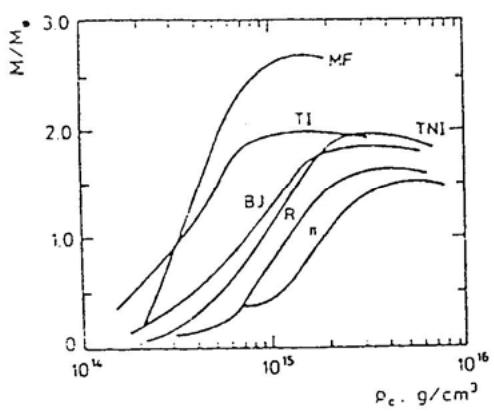
The figure summarises mass-radius and mass-density relations from different neutron-star models. Modern equations of state are still an active topic of research, but the basic impression remains: a mass comparable to the Sun packed into a radius of only about ten kilometres.
Why this chapter pays off later
Once you know how neutron stars form, many later quantities become much easier to interpret:
- such a small radius is what permits millisecond rotation
- such high density is what makes internal structure and glitch phenomena plausible
- such extreme gravity and magnetic fields are what make complex magnetospheres and high-energy particle acceleration possible
Continue with:
Chapter 2. Pulsar Observing Techniques
Follow the original chapter through sensitivity, large telescopes, folding, dedispersion, and survey strategy to see why pulsar detection depends on both hardware and signal processing.
Chapter 4. Timing Properties of Pulsar Pulses
Use period, period derivative, binaries, timing noise, and glitches to see why measuring pulse arrival times opens up an entire physical parameter set.