Chapter 1. Discovery of Pulsars
Reconstruct the path from the theoretical prediction of neutron stars to the discovery of pulsars and their later identification as rotating neutron stars.
1. The prediction of neutron stars and the discovery of pulsars
Long before pulsars were discovered, physicists had already predicted the existence of neutron stars. By 1933, theory had suggested an object with roughly one solar mass, a radius of only about ten kilometres, and a density on the order of . Yet for decades no such object was identified observationally.
Astronomers struggled for a long time with the problem of the Crab Nebula's energy source, and some speculated that a neutron star might exist inside the nebula. One of the most remarkable early predictions came from the Italian astronomer Pacini, who argued shortly before the discovery of pulsars that the Crab Nebula might contain a strongly magnetised, rapidly rotating neutron star whose magnetic-dipole radiation powered the nebula. That prediction later proved strikingly accurate.
The breakthrough came in 1967, when Antony Hewish and his graduate student Jocelyn Bell, while studying interplanetary scintillation at Cambridge, detected a highly unusual radio source whose radiation arrived in periodic pulses. The period was about 1.33730 seconds and extraordinarily stable:
At the same time, the period increased only very slowly, with a measured rate of roughly
This was an astonishing discovery. Today such objects are universally recognised as radio pulsars, that is, neutron stars that emit periodic radio pulses.
At first, however, the nature of the new source was not obvious. Because the signal resembled an artificial sequence of pulses, astronomers briefly joked that it might be a message from extraterrestrial intelligence; the earliest pulsars were even nicknamed the "little green men." That interpretation quickly failed once more pulsars were found all over the sky. Their periods differed, but their signals shared the same basic character, and there was no sign of orbital information of the kind one would expect if the transmitter were a planet orbiting another star.
The naming convention that eventually won out used the abbreviation PSR from "pulsar" together with the source position on the sky. The first pulsar became PSR1919+21, where 1919 refers to the right ascension and +21 to the declination. Later, when the number of pulsars increased, more digits were added. The naming system was revised again after the 1993 Taylor catalogue to distinguish older B1950 positions from newer J2000 positions. Thus the first pulsar could appear either as PSRB1919+21 or, in the newer system, PSRJ1921+2153.
2. Hewish's contribution
Why was the discovery of neutron stars so difficult, and why did Hewish's group succeed?
The first reason was theoretical. Astronomers had no correct prediction of the radiation properties of neutron stars. They did not know that neutron stars would be strong radio emitters, and they certainly did not know that the emission would appear in narrow pulses. Optical astronomy was the best-developed observational field at the time, but a neutron star has a surface area billions of times smaller than that of an ordinary star, so its optical luminosity is correspondingly faint. In practice, observers had likely recorded radiation from neutron stars in optical, radio, and X-ray observations even before pulsars were recognised, but they did not know what they were looking at.
The second reason was observational technique. Radio sensitivity is measured by the minimum flux density that a telescope can detect. Flux density is expressed in janskys:
Most pulsars are very faint, often below 0.1 Jy, whereas the noise floor of a large radio telescope can be about 100 Jy. That means pulsar pulses are usually buried in the noise unless observing strategy and signal processing are adapted specifically for them.
Sensitivity also improves when the receiver integrates for longer, so astronomers often preferred time constants of one minute or even several hours. But this smoothing destroys short-period signals. A strong pulsar such as PSR0833-45 in Vela has a peak flux density of thousands of janskys at 400 MHz, easily above telescope noise, yet its period is only 0.089 seconds. With too long a time constant, even such a source would simply look like an ordinary radio emitter.
Hewish's good fortune came from his long-standing work on interplanetary scintillation. Scintillation is a rapid fluctuation in radio intensity caused by irregularities in the medium through which the waves travel. Hewish had argued as early as 1954 that sufficiently compact radio sources could show measurable interference effects after passing through the solar corona. By the early 1960s, observations of rapidly varying radio sources and the discovery of quasars had made this a major line of research.
In 1965 Hewish had already made an observation closely related to the later pulsar discovery: using interplanetary scintillation, he found a compact component in the Crab Nebula with an angular size of only about 0.2 arcseconds and a brightness temperature of about . He suggested that this component was the remnant of the 1054 supernova. In 1969 that compact component was indeed identified as the Crab pulsar.
The large Cambridge telescope built for interplanetary scintillation work turned out to be almost ideally suited for pulsar detection. It had a collecting area of more than 21,000 square metres, observed at a long wavelength of 3.7 metres where pulsar radio emission is strong, and, crucially, used a time constant of about 0.1 seconds. It repeatedly scanned large parts of the sky, exactly what scintillation studies required, and this combination made the discovery of pulsars possible.
Once Bell found the "anomalous scintillating source," Hewish immediately threw himself into confirming it. After excluding interference and considering other interpretations, he and his colleagues used a rapid recorder and accurate time standards to measure the period more precisely, correcting for Earth's orbital motion. The 1968 Nature paper by Hewish and collaborators announced the first pulsar. In 1974 Hewish shared the Nobel Prize in Physics with Martin Ryle for pulsar discovery and radio-astronomical techniques.
The discovery was accidental in one sense, but it was also historically inevitable. Once radio telescopes reached the right combination of sensitivity and time resolution, pulsars were bound to appear. The real delay had come from the absence of correct theoretical guidance.
3. Astronomers do not forget Jocelyn Bell's contribution
Jocelyn Bell herself once joked that while she was working on a new technique for her doctorate, a group of "little green men" had chosen her antenna and her observing frequency for communication. But the discovery was not luck alone.
In fact, the 76-m telescope at Jodrell Bank had apparently recorded pulsar signals more than a decade before the official discovery, during surveys of the cosmic background, but those signals were not recognised for what they were. Bell's crucial contribution was her persistence and attention to detail.
The Cambridge array that Bell used was less powerful than some other radio telescopes, but Bell noticed an unusual signal appearing around local midnight, when solar-wind scintillation should be weak because the Sun was on the far side of Earth. Recognising such signals was difficult, since radio telescopes constantly recorded interference from car ignitions, motors, transmitters, and satellites. Those signals also appeared as pulses on the chart recorders, and many observers had become accustomed to dismissing them.
Bell did not dismiss them. She pursued the anomaly that first appeared in August 1967, and after more than two months of effort she obtained a clear fast-recorder trace on 28 November showing periodic pulses with a period of about 1.337 seconds. The source was first described as a "rapidly pulsing radio source" and soon thereafter became known as a pulsar. A second pulsar was found on 25 December. By January 1968, after re-examining thousands of metres of chart paper, Bell had identified two more pulsars.
Without her care and persistence, the observational discovery of neutron stars might have been delayed much longer. Figure 1.1 in the original text shows the first records of PSR1919+21. The initial trace looked very similar to interference and could easily have been ignored; only the later fast-recorder trace made the periodic pulses unmistakable.
Bell's contribution therefore went well beyond noticing an oddity. Hewish provided decisive leadership in ruling out interference and in demonstrating that pulsars were the long-predicted neutron stars, but Bell was central to the discovery itself. Many pulsar researchers have long felt that the Nobel recognition should also have gone to her. The pulsar community has repeatedly honoured her importance even though she later moved into different areas of astronomy.
4. How pulsars were identified as neutron stars
Once pulsars had been discovered, the central questions became immediate: what kind of object is this, and how are such accurate periods produced?
4.1 The key observational clues
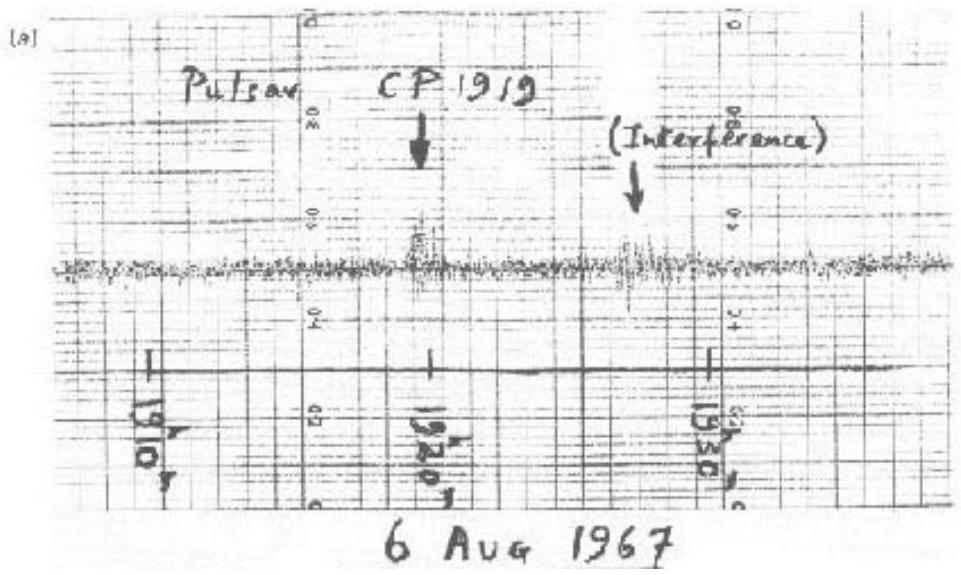 Figure 1.1a. The first record of PSR1919+21 looked very much like interference.
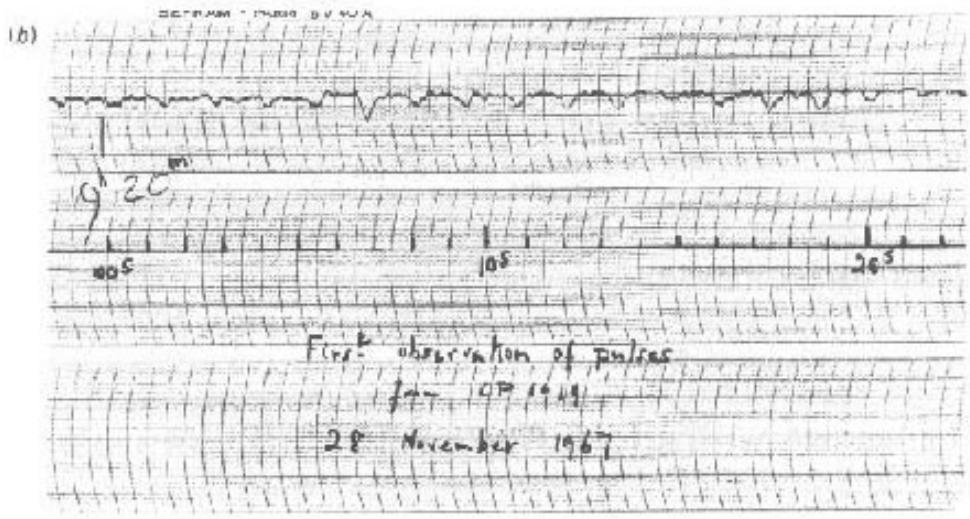 Figure 1.1b. The fast-recorder trace showing the individual pulses of PSR1919+21.
Pulsar observations supplied a remarkable set of clues:
- the radiation arrived as periodic pulses
- the periods were far shorter than almost any previously known astronomical periodicity
- the periods were extraordinarily stable
- most periods increased slowly with time
- the pulse width was only a small fraction of the full period, typically a few percent
Early observations placed pulsar periods between 33 milliseconds and 4.3 seconds. Today the known range extends from 1.56 milliseconds to 8.5 seconds. Those values are much shorter than the periods of planetary rotation, planetary orbital motion, eclipsing binaries, or most variable stars.
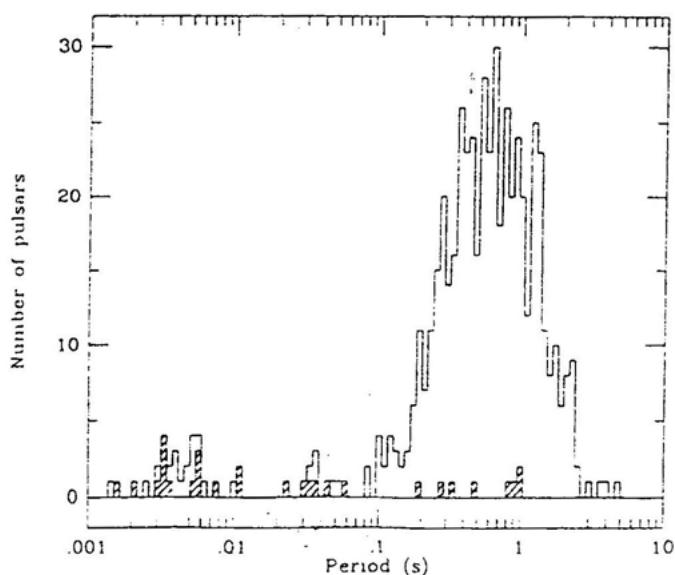 Figure 1.2. Period distribution of pulsars in the 558-source sample, with pulsar binaries shown by hatching.
The extraordinary stability of pulsar periods, especially in millisecond pulsars, rivals atomic clocks. The gradual increase in period is also critical: most pulsars slow down, though a tiny number show negative period derivatives. And the fact that the pulse itself occupies only about of the rotational cycle demands a beamed or geometrically confined origin.
4.2 Possible origins of the period
Three main ideas were explored.
(1) Binary orbital motion
One possibility was that the pulsar period reflected the orbital period of a binary system. Binary stars are common in the Galaxy, and close binaries can have very short orbital periods. But to reproduce second-scale or millisecond-scale periods, the component stars would need to be implausibly small and dense.
Applying Kepler's third law to a binary gives
If the orbit is made short enough to match the Crab pulsar's 33-ms period, the maximum stellar radius becomes only on the order of a hundred kilometres, with a minimum density far above that of white dwarfs and much closer to the theoretically predicted density of neutron stars.
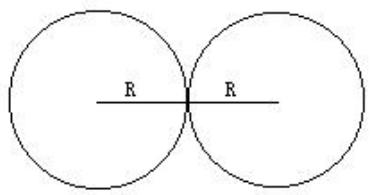 Figure 1.3. The contact-binary limit.
Even that is not enough. General relativity predicts that such an extreme compact binary would emit intense gravitational radiation, causing the orbital period to shrink rapidly. Observationally, pulsar periods mostly increase with time. That contradiction rules out ordinary binary orbital motion as the general explanation for pulsar periods.
(2) Radial stellar pulsation
Another idea was that pulsars might be pulsating stars, analogous to Cepheids or other radial pulsators. In a pulsating star, rhythmic expansion and contraction produce periodic brightness variations.
Eddington derived the approximate relation
which links pulsation period to mean density. White-dwarf densities could give periods of order ten seconds, still far longer than most pulsar periods. Neutron-star densities might allow periods of 1-10 milliseconds, which could fit only a small subset of pulsars, not the whole population. More importantly, radial pulsation cannot naturally produce the exquisite period stability observed in pulsars. That possibility was therefore discarded.
(3) Stellar rotation
The remaining idea was that pulsars are rapidly rotating stars. Rotation is common among stars, but nothing known at the time rotated remotely this fast. Could any star do so?
Two limits apply. First, the equatorial speed cannot exceed the speed of light. Ordinary stars are far too large to rotate at millisecond periods without violating that limit. Second, the centrifugal force at the equator must not exceed gravity:
This can be rewritten as a relation between period and density:
For neutron-star densities, even periods as short as 1 millisecond are still possible. The shortest known pulsar periods lie just in the allowed range. White dwarfs, by contrast, can only support minimum periods of about 1 second, so they cannot explain the full pulsar population.
A theoretical neutron star has no sustained nuclear burning. Its radiation must ultimately be powered by the loss of rotational energy, so its spin should gradually slow with time. That matches the observed positive period derivatives. The famous lighthouse model then explains why the pulse occupies only a small fraction of the period: radiation emerges in beams, and we detect a pulse only when the beam sweeps across our line of sight.
By this chain of reasoning, the interpretation of pulsars as rapidly rotating magnetised neutron stars became widely accepted.
5. Supernova explosions as the main formation mechanism for neutron stars
Soon after neutron stars were predicted, astronomers also proposed that they are produced by supernova explosions. This idea needed observational confirmation.
In 1968, a pulsar was discovered near the edge of the Vela supernova remnant: PSR0833-45, with a short period of 0.089 seconds. Its distance and age matched those of the remnant. Its offset from the remnant centre could be explained by the pulsar's own high space velocity. This was a key demonstration that the pulsar had been born in the supernova explosion.
That discovery strongly encouraged the search for a neutron star in the Crab Nebula. It was quickly found. The Crab pulsar, PSR0531+21, has a period of 0.033 seconds and a known historical age because the Crab Nebula is associated with the supernova recorded in 1054. The pulsar lies very close to the remnant centre and is one of the youngest known pulsars. Together, the Vela and Crab pulsars became decisive evidence that supernova explosions produce neutron stars.
These two pulsars are important for another reason: their radiation spans the full electromagnetic spectrum, from radio to optical, X-ray, and -ray bands, making them among the most intensively observed pulsars of all.
Supernova remnants do not last very long on astronomical timescales, only of order a few hundred thousand years, whereas pulsars live much longer. Most pulsars therefore no longer show an obvious associated remnant. In addition, pulsars have typical space velocities of about 100 km/s, so older pulsars may have moved far away from their birth sites. Even so, younger pulsars continue to reveal strong statistical and direct links with supernova remnants.
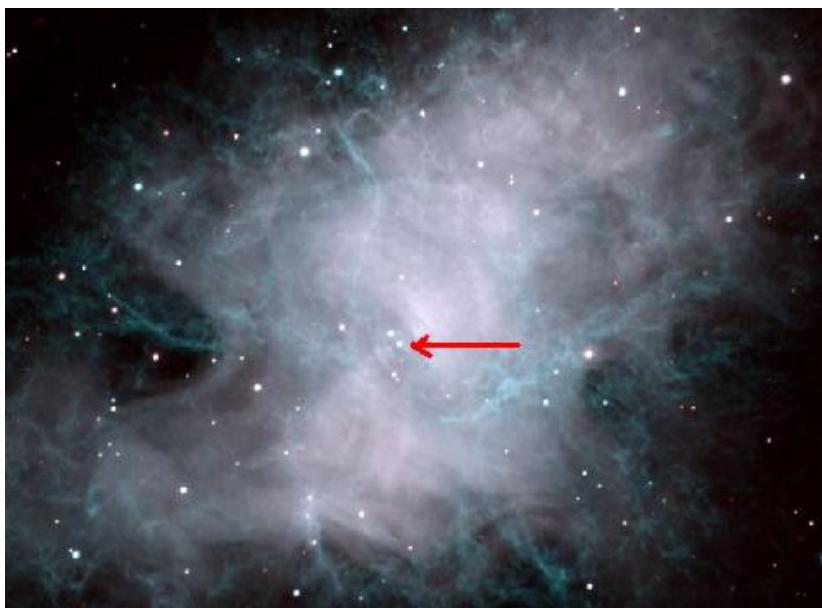 Figure 1.4. The Crab Nebula and its pulsar.
The original text also points to the spatial distributions of supernova remnants and young pulsars in the Galaxy. Pulsars younger than about one million years cluster near the Galactic plane in a pattern very similar to that of supernova remnants.
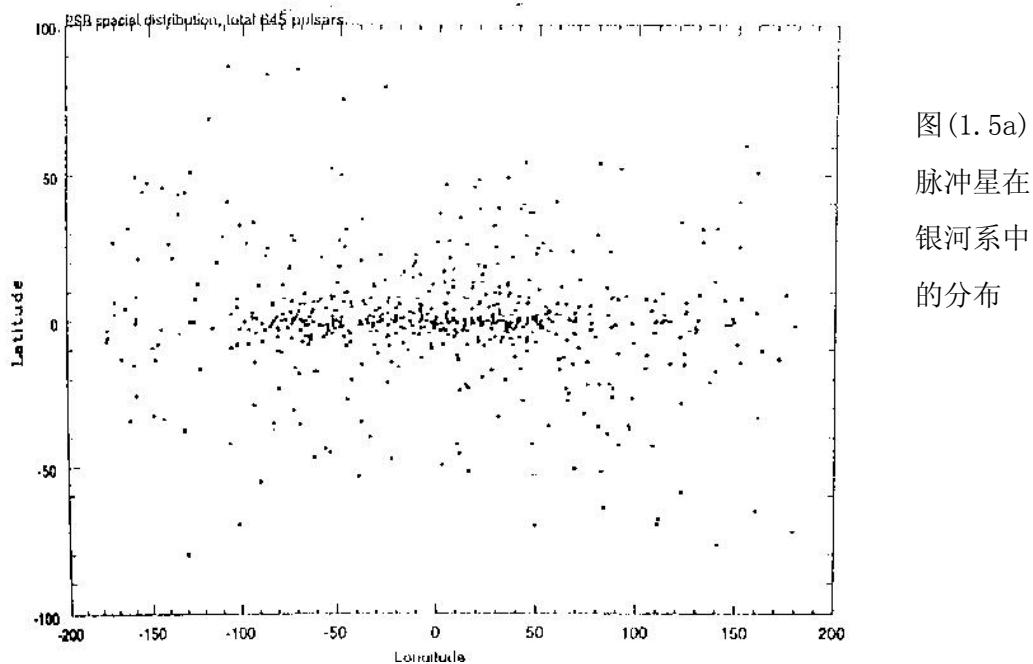 Figure 1.5b. Distribution of supernova remnants in the Galaxy.
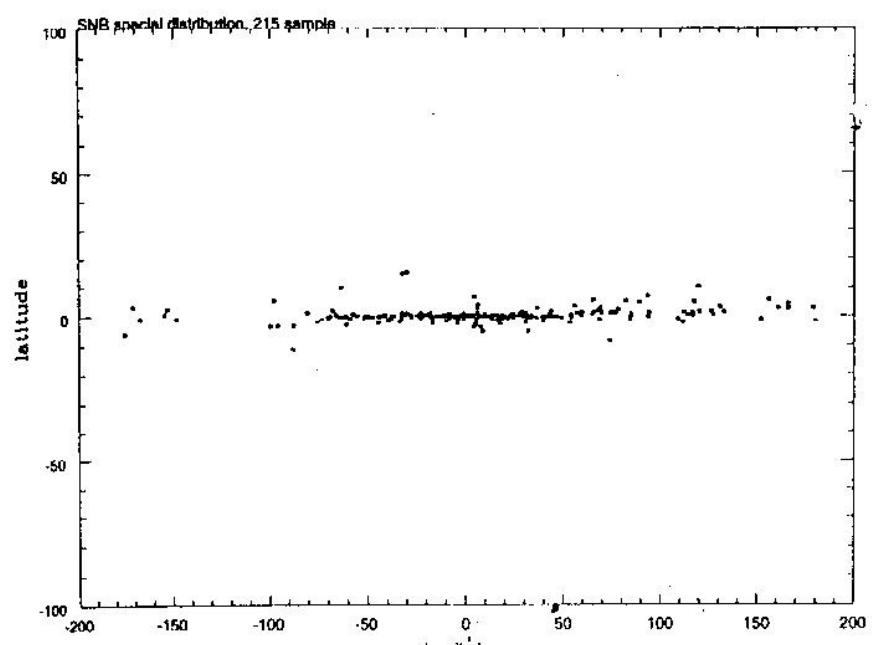 Figure 1.5c. Distribution of pulsars younger than one million years.
The conclusion is that supernova explosions are the main formation mechanism for neutron stars, and pulsars provide one of the clearest observational routes for proving it.
Preface
The preface to Pulsar Physics, outlining why pulsar research became central to the study of neutron stars, gravity, binaries, and the interstellar medium.
Chapter 2. Pulsar Observing Techniques
Follow the original chapter through sensitivity, large telescopes, folding, dedispersion, and survey strategy to see why pulsar detection depends on both hardware and signal processing.