Chapter 9. Millisecond Pulsars and Binary Systems
Understand why millisecond pulsars are treated as recycled objects and how binary evolution rewrites the history of spin and magnetic field.
This chapter separates ordinary pulsars from recycled pulsars. That distinction matters because a millisecond pulsar is not merely a pulsar that happens to spin a bit faster. It is the result of a different evolutionary branch.
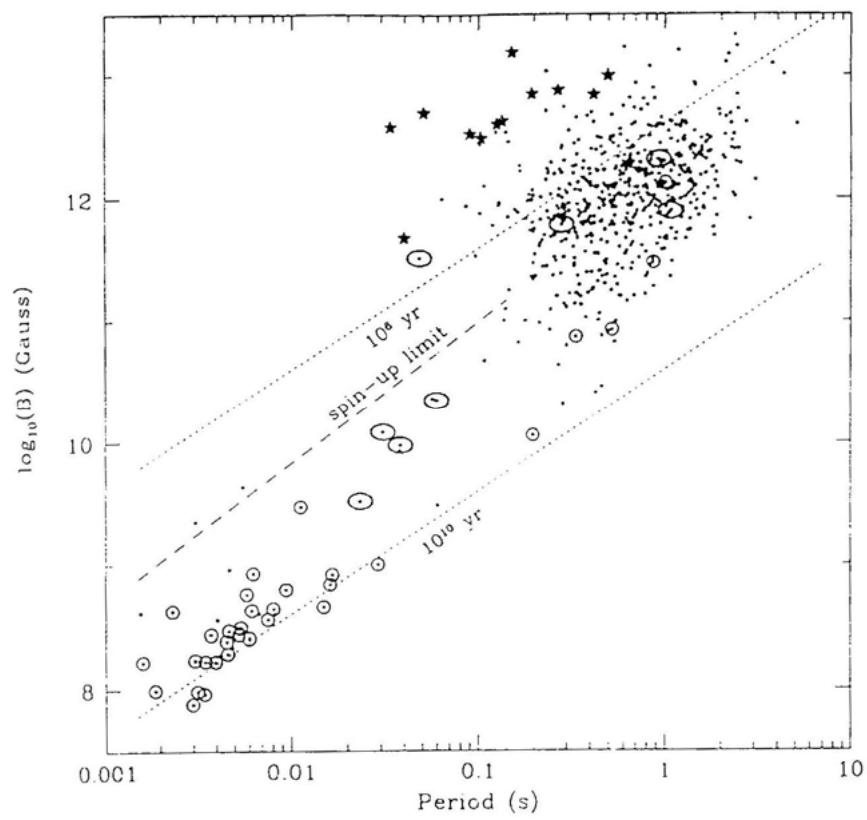
The figure shows the three most characteristic properties of the millisecond-pulsar population at a glance: short periods, low magnetic fields, and high stability. They do not simply extend the trend of ordinary young pulsars. They look more like a population that has been driven back into a rapid-rotation regime.
Why millisecond pulsars were so surprising
When the first millisecond pulsar was discovered in 1982, the real surprise was not just that another source had been added to the catalogue. The shock came from the combination:
- a period in the millisecond range
- but not a young, high-field object like the Crab pulsar
- instead an old, weak-field, extremely stable source
That forced astronomers to accept that pulsars do not all simply spin down from birth in one uninterrupted track. Some are spun back up later in life.
Why binaries are the missing key
The book places the explanation in the X-ray-binary stage. If a neutron star and a companion form a binary, matter from the companion can be transferred through an accretion disc onto the neutron star, bringing angular momentum with it. Two consequences follow:
- the star is spun up to millisecond periods
- the magnetic field appears to weaken or be reconfigured
That is why millisecond pulsars are interpreted as recycled pulsars.
Why so many millisecond pulsars remain in binaries
This is not a coincidence. It is direct evidence of their evolutionary history. If spin-up happens in binaries, then many of the descendants should still retain companions. The book goes on to discuss:
- neutron-star-white-dwarf systems
- double-neutron-star systems
- black widow and related eclipsing binaries
- even special cases with planetary companions
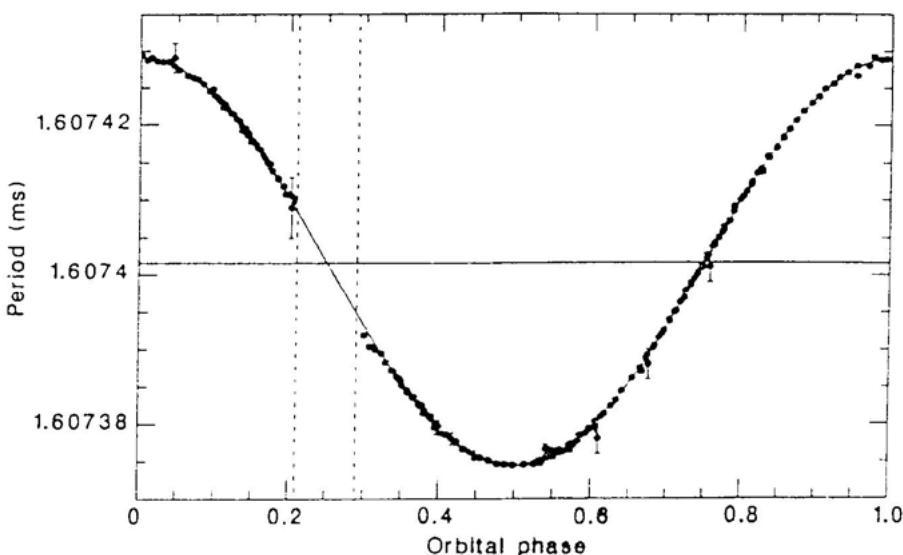
Systems such as PSR1957+20 are especially instructive because they show, almost directly, a pulsar wind ablating the companion star over time.
Why this chapter is inseparable from precision timing
Millisecond pulsars matter so much in modern research not simply because they spin fast, but because their arrival times are stable enough to:
- test general relativity
- contribute to pulsar timing arrays
- search for the nanohertz gravitational-wave background
- build highly stable astrophysical time standards
Continue with:
Chapter 8. The Polar-cap Geometry Model
Use open field lines, emission cones, and position-angle swings to translate mean pulse profiles into magnetic geometry.
Chapter 10. Evolution of Pulsars
Follow pulsars from supernova birth and remnant associations to population migration across the P-Pdot diagram.