Chapter 7. Radiation Mechanisms of Pulsars
Follow the chain from the magnetosphere and charge separation to particle acceleration, curvature radiation, and inverse Compton scattering to understand the engine behind the mean pulse.
After Chapter 6 lays out a wide range of observational facts, this chapter turns directly to the harder question: how is that radiation actually produced inside the magnetosphere?
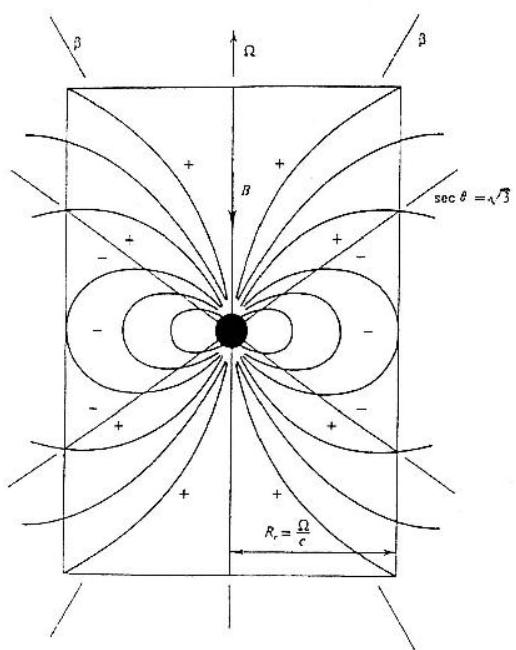
The Goldreich-Julian magnetosphere is the starting point of the chapter. It tells us that the region around a neutron star is not empty space, but a corotating magnetosphere made from rotation, electric fields, magnetic fields, and charged particles.
Why the magnetosphere is not optional background
The book first pushes back against the naive idea that a neutron star simply has no atmosphere at all. For a neutral atmosphere, gravity would indeed make the layer extremely thin. But once the strong electric field induced by a rotating magnetic field is included, electromagnetic forces can pull charged particles off the surface and build a magnetosphere.
That step matters because every later high-energy process depends on it:
- where particles come from
- how particles are accelerated
- where radiation is produced along open field lines
- how positive and negative charges are distributed
Why GJ density and the light cylinder define the coordinate system
The book introduces two classical ideas at this stage:
- the Goldreich-Julian charge density
- the light cylinder
The first gives the rough charge distribution required for corotation. The second defines the geometric boundary beyond which rigid corotation would exceed the speed of light. Many later models are really asking the same question in different forms: where do particles depart from ideal corotation, and where do acceleration and radiation zones appear as a result?
Why the crucial idea is the gap
A magnetosphere alone is not enough. You still need electric-field regions that can push particles to ultra-relativistic energies. The book places the source of high-energy electrons in accelerating structures such as inner gaps. The logic is:
- in ideal MHD, the electric field parallel to a magnetic field line should be screened
- if charge supply is insufficient in some region, an unscreened accelerating field can appear
- once particles are accelerated, cascades and radiation follow
Why several radiation mechanisms can coexist
The chapter discusses cyclotron radiation, synchrotron radiation, curvature radiation, and inverse Compton scattering in turn. For documentation readers, the most useful thing to remember is the kind of motion each mechanism corresponds to:
- spiralling motion around field lines produces cyclotron or synchrotron radiation
- rapid motion along curved magnetic field lines produces curvature radiation
- scattering between energetic particles and low-energy photons produces inverse Compton emission
These mechanisms are not always mutually exclusive. Different regions and different energy bands may involve several of them at once.
Why the value of this chapter is the question framework
Pulsar emission is still not a fully closed problem, so the most durable part of the chapter is the way it teaches you to ask the problem:
- where do the particles come from
- where are they accelerated
- by what mechanism do they radiate
- how do those mechanisms connect to observed profiles, spectra, and polarization
Continue with:
Chapter 6. Radiation Properties of Pulsars
Move from single pulses and subpulses to mean profiles, polarization, and multiwavelength pulse shapes to understand what a pulsar actually looks like in observations.
Chapter 8. The Polar-cap Geometry Model
Use open field lines, emission cones, and position-angle swings to translate mean pulse profiles into magnetic geometry.