Chapter 10. Evolution of Pulsars
Follow pulsars from supernova birth and remnant associations to population migration across the P-Pdot diagram.
This chapter pulls together the evolutionary hints that appeared earlier. A pulsar is no longer just a neutron star that happens to pulse. It becomes one stage inside the broader evolution of compact objects born from stellar death.
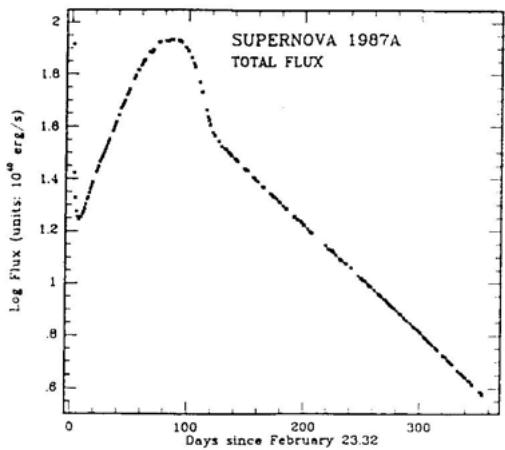
Using SN1987A as an example, the book reminds us that a supernova is not merely background scenery. It is the observational birth site of neutron stars and black holes.
Why supernovae are the starting point
The chapter begins with the basic properties of supernova explosions: enormous energy release, remnant formation, and the survival of a compact core. Its role is to place pulsars back inside the main narrative of stellar death:
- the progenitor star constrains what kind of compact remnant is possible
- the explosion dynamics shape the later remnant and surrounding environment
- whether the remnant is later visible as a pulsar also depends on magnetic field, rotation, and beam orientation
Why pulsar-remnant associations matter so much
The book repeatedly returns to the Crab Nebula, not just because it is famous, but because it combines three rare advantages:
- a well-constrained historical age
- an observable supernova remnant
- a central pulsar that can be monitored over long timescales
Samples like this turn the statement "supernovae produce neutron stars" from a plausible story into a repeatedly testable empirical fact.
Why the P-Pdot diagram is a population roadmap
Once many pulsars are placed on a - diagram, we can stop thinking only about individual sources and start looking at how whole populations move through parameter space:
- young ordinary pulsars usually begin in the short-period, high- region
- as they spin down and their magnetic properties evolve, they move toward the lower-right
- millisecond pulsars that were spun up through accretion occupy a separate region
In the simplest magnetic-dipole braking approximation, if the braking index is , then
That is why ordinary pulsars often appear to drift diagonally toward the lower-right on the diagram. Reference lines of constant characteristic age and constant field are commonly written as
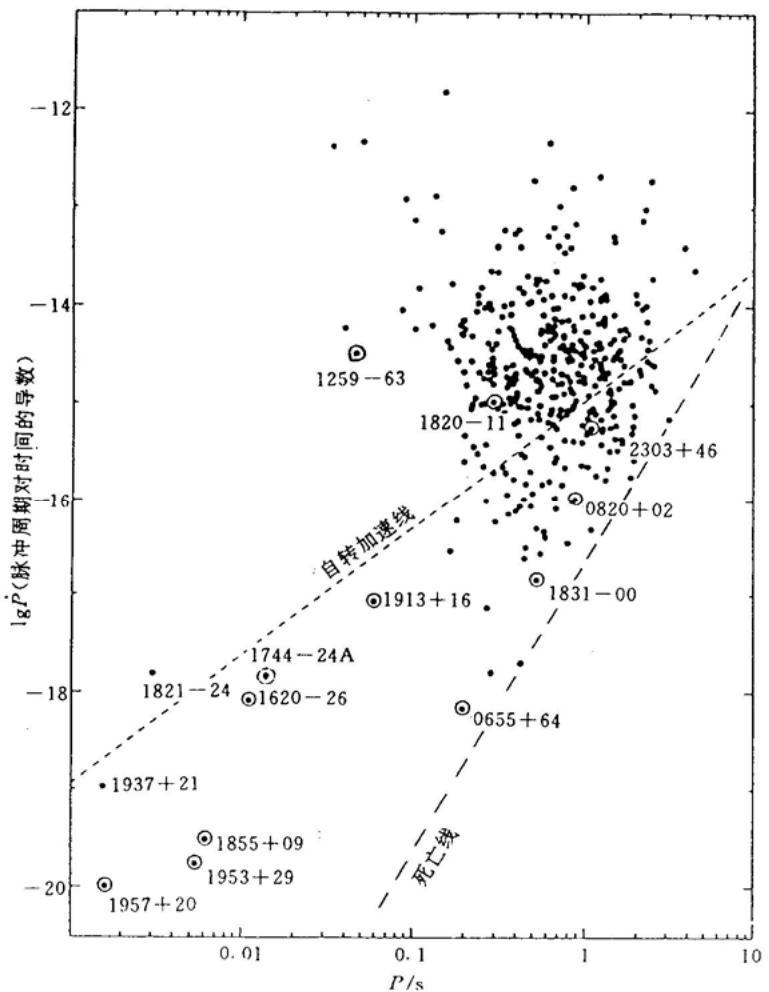
For many readers this map is more useful than memorising a list of individual sources, because it compresses age, field strength, energy loss, and population type into a single picture.
The main ideas worth keeping
Some numerical values and source statistics in the original book clearly belong to an earlier era, but the evolutionary framework is still very worth keeping:
- ordinary pulsars and millisecond pulsars are not just different points along one simple sequence
- supernova history, binary interaction, and magnetic-field evolution together shape pulsar populations
- every observational "class" corresponds to a distinct formation or evolutionary channel
Continue with:
Chapter 9. Millisecond Pulsars and Binary Systems
Understand why millisecond pulsars are treated as recycled objects and how binary evolution rewrites the history of spin and magnetic field.
Chapter 11. Pulsars and the Interstellar Medium
Use dispersion, Faraday rotation, scintillation, and scattering to turn pulsars from the object of study into probes of the medium between the stars.